

You started a GLP-1. Month six or seven arrives. Suddenly there is hair in the shower drain, hair on the pillow, hair in your hands.
It is frightening, it is common, and it is almost always temporary. Here is the science of what is going on, what the evidence actually says, and the honest answer on what haircare can and cannot do about it.
Yes, it is a reported effect
You are not imagining it and you are not an outlier.
Hair loss appears in the prescribing information for semaglutide, reported in 3.3 per cent of adult patients in the Wegovy trials, and it is also reported in the prescribing information for tirzepatide. So it is a documented adverse effect rather than internet folklore.
What that number also tells you is that the large majority of people do not experience it. If you are one of the people who does, the next part matters more than the statistic.
The mechanism, and why timing is the giveaway
This is the bit that makes everything else make sense.
Your hair grows on a cycle. Follicles move through a growing phase, a short transition phase and a resting phase, and a significant physiological stressor can push an unusually large number of follicles out of the growing phase and into rest at once. Those hairs then let go together, two to three months after the event that triggered it.
That condition has a name. The Australasian College of Dermatologists describes telogen effluvium as a diffuse shedding of hair following a trigger, which is typically temporary.
And the trigger list is the important part. Rapid weight loss, reduced energy intake and inadequate protein or micronutrient intake are all recognised causes of exactly this pattern.
Why the delay confuses everyone
Because the shedding shows up months after the trigger, people naturally blame whatever happened last week. In reality it is reporting on what your body was doing in the first few months of significant weight loss. People in this situation describe onset around month six to nine and the heavy phase lasting roughly three months.
Is it the drug, or is it the weight loss
Fair question, and worth being precise rather than confident.
Note the wording. Plausible and likely, not proven and closed. The honest position is that weight loss driven telogen effluvium is the leading explanation and the research is still developing.
There is a useful real world signal in this too. People who lose significant weight by any method, including surgery and dieting, report the same shedding. And people who manage their intake well on a GLP-1 sometimes report their hair improving, because they are eating a better diet than they were before.
What the evidence suggests actually helps
Most of this is not a haircare conversation, which we would rather say plainly than pretend otherwise.
|
Lever |
Why it matters |
Who to talk to |
|---|---|---|
|
Protein intake |
Hair is protein, and appetite suppression makes it easy to undereat |
Your GP or a dietitian |
|
Iron, zinc and overall nutrition |
Deficiencies are recognised contributors to shedding |
Your GP, who can test rather than guess |
|
Rate of weight loss |
Faster loss is associated with more shedding |
Your prescriber |
|
Time |
Acute shedding of this kind is usually self limiting |
Nobody. This one is patience. |
|
Persistent shedding past six months |
May point to something other than telogen effluvium |
A doctor or dermatologist, properly assessed |
Australian health guidance is to see a doctor when hair loss is greater than usual, comes with feeling unwell, or affects other areas of the body. Shedding that never settles is worth investigating rather than enduring.
The honest answer on haircare
Here is where we draw a hard line, because the category is full of products implying otherwise.
The hair shaft you can see and touch is made of non-living keratinised cells, while the living machinery that grows it and sets its cycle sits down in the follicle. Topical products act on the fibre. They do not reach into the follicle and restart the growth phase.
So no shampoo, mask or treatment, ours included, will stop telogen effluvium. Anything marketed as doing that is overpromising.
What it can genuinely do
There is still a real job here, and it is worth understanding. Published guidance on hair cosmetics for patients experiencing hair loss notes the role of cosmetic products in improving the appearance and handling of the hair that is present, and in reducing breakage.
That matters more than usual right now. You have fewer strands than you did. Losing additional length to breakage from heat, colour and brushing on top of that is a compounding problem, and it is the one part of this situation that a repair product actually addresses.
Put bluntly, we cannot change how much you shed. We can make sure the hair you keep is as strong as it can be.
[collection-carousel="treatment"]
A gentler routine for a shedding phase
Fewer interventions, less tension, more protection. That is the whole brief.
-
Reduce heat styling. The single highest leverage change, and free.
-
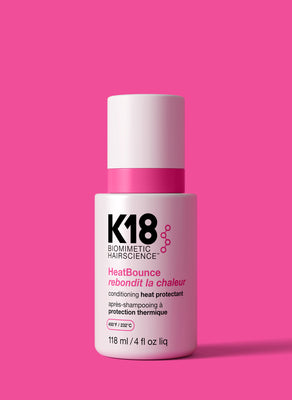
Protect when you do use heat. Our HEATBOUNCE conditioning heat protectant is built for this job specifically.
-
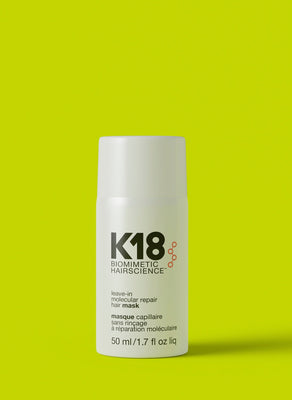
Repair the fibre, do not just coat it. The leave-in molecular repair hair mask works at the molecular level inside the strand.
-
Stop pulling. Tight ponytails and aggressive detangling cost you strands you did not have to lose.
-
Detangle wet, gently, from the ends up. Water weakens hydrogen bonds, so be careful rather than quick.
-
Hold off on new chemical services. This is not the month for a big lift.
[product-feature="k18-leave-in-molecular-repair-hair-mask-5ml"]
Keeping damage out in the first place
Prevention is doing more work than repair during a shedding phase.
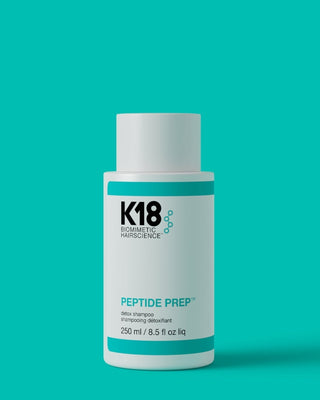
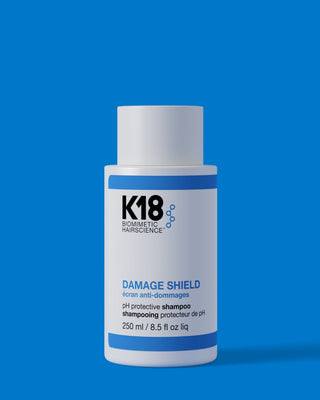
A pH protective wash is a sensible swap while things settle, because cleansing is the step you repeat most often. Our damage shield pH protective shampoo is formulated to clean without adding to the problem.
If you want the deeper science on how we approach damage at a molecular level rather than a surface one, our FutureIQ hub is the place to go.
[product-feature="damage-shield-ph-protective-shampoo"]
[collection-carousel="bestsellers"]
The short version
-
Hair loss is a documented reported effect of semaglutide and tirzepatide.
-
It was reported in 3.3 per cent of adult patients in the Wegovy trials.
-
Most people on these medications do not experience it.
-
The pattern fits telogen effluvium, a diffuse temporary shedding after a trigger.
-
Shedding typically starts two to three months after the trigger, not immediately.
-
Rapid weight loss and low energy, protein or micronutrient intake are recognised triggers.
-
A systematic review attributes GLP-1 associated shedding mainly to weight loss and nutrition rather than direct drug toxicity.
-
That attribution is described as plausible and likely, not settled.
-
People losing weight by any method report the same thing.
-
Protein intake and tested nutrient levels are the highest value levers.
-
Ask for blood tests rather than guessing with supplements.
-
Acute shedding of this kind is usually self limiting.
-
Shedding that persists past six months deserves proper assessment.
-
The hair shaft is non-living, so no topical product can restart the growth cycle.
-
No shampoo or mask stops shedding, ours included.
-
What haircare can do is stop you losing more hair to breakage on top of it.
The reassuring part is the timeline. For most people this is a phase with a beginning and an end, and the hair comes back while still on the medication. The useful part is what you control in the meantime, which is nutrition with your doctor, and protecting every strand you still have.
