

Short answer. Yes, and it almost certainly already has.
Longer answer, and the one that actually helps. Porosity is not a hair type you were assigned at birth. It is mostly a measure of how damaged your cuticle is, which means it moves in one direction easily and the other direction barely at all.
Here is what is really going on, and why the glass of water on your bathroom bench is not telling you anything.
What Porosity Actually Is
Porosity describes how readily hair takes up and holds water, and it is governed almost entirely by the cuticle, the overlapping scales on the outside of the strand.
Cuticle flat, intact and tightly packed. Water struggles to get in, products sit on top, hair takes forever to dry. That is low porosity.
Cuticle lifted, chipped or missing. Water rushes in and rushes back out, hair soaks and dries fast, and nothing seems to stay put. That is high porosity.
Which means porosity is not really a personality trait of your hair. It is a damage report.
The Float Test Does Not Work
Time to retire this one. You pull out a strand, drop it in a glass of water, and read your fate from whether it sinks.
The problem is that the test measures surface tension more than porosity. Whether a hair floats depends on residue from product, natural oils, how you handled it, whether it was already wet, and how you dropped it in. Clean, oil free hair sinks fairly readily whatever its condition.
To be fair about the evidence, there is no rigorous study formally validating or invalidating the float test either way. That is rather the point. It became universal advice without anyone ever demonstrating it works.
If you want a more useful read on your own hair, our hair porosity test is a better starting point than a drinking glass.
[tip-text="A better everyday signal than any float test. Time how long your hair takes to air dry, and notice whether product absorbs or sits on the surface. Behaviour tells you more than buoyancy."]
How Porosity Is Really Measured
Worth knowing what the actual methods are, if only to see how far the glass of water sits from them.
Laboratory porosity measurement uses water uptake and swelling measurements, dye uptake as a marker of damage, and microscopy to look directly at the cuticle. Some newer work uses gas sorption to characterise pore structure properly.
None of that is available in your bathroom. But it does tell you that porosity is a real, measurable physical property rather than an invented category, which is more than can be said for most hair typing systems.
What Raises Porosity
Everything here works by damaging the cuticle. That is the whole list, in rough order of impact.
|
Cause |
What it does |
How fast |
|---|---|---|
|
Bleaching and lightening |
Lifts and strips cuticle, degrades internal structure |
Immediate and substantial |
|
Permanent colour and relaxers |
Alkaline chemistry swells and opens the cuticle |
Immediate, cumulative |
|
Heat styling |
Denatures keratin, lifts and cracks cuticle |
Cumulative |
|
UV exposure |
Oxidative damage to proteins and lipids |
Slow and constant |
|
Mechanical wear |
Abrasion from brushing, towels and friction |
Slow and constant |
Bleaching is comfortably the biggest lever, and it does structural damage well beyond the surface. Thermal styling damages both cuticle and cortex, and it accumulates rather than resetting between uses.
Then there is the one nobody counts. Ultraviolet radiation oxidises hair proteins and lipids, concentrated in the cuticle. Every summer costs you something, quietly, for free.
Our guide to what bleaching actually does covers the biggest one properly.
One Strand, Several Porosities
Here is the detail that reframes the whole subject.
Your hair does not have a porosity. Different parts of the same strand have different porosities, because they are different ages.
The hair near your scalp is a few weeks old and has been through almost nothing. The ends of shoulder length hair are around two years old and have survived every wash, brush, blow dry, colour and summer since. Porosity increases along the length for exactly that reason.
So the answer to whether your porosity changed over time is visible on a single hair. Root to tip is a timeline.
The Part Nobody Wants To Hear
Porosity goes up easily. Getting it back down is a different matter, and this is where most content on the subject quietly misleads.
The hair shaft is made of dead, fully keratinised cells. There is no blood supply, no metabolism and no healing. Once a cuticle scale is torn away, your body will not grow it back, because that part of the hair is no longer biologically alive.
So when someone says their hair went from high porosity to low porosity, one of three things happened. They cut the damaged length off. New, undamaged hair grew in and now dominates. Or products are temporarily masking the behaviour.
All three are legitimate outcomes. None of them is a destroyed cuticle regenerating.
What Products Can And Cannot Do
Worth being precise here, because this is exactly where haircare marketing gets sloppy.
Surface Work
Conditioners and film forming polymers deposit a layer on the hair surface, filling cuticle gaps, smoothing the fibre, cutting friction and reducing water uptake.
That is genuinely useful. Hair looks better, feels better and behaves less porously. It also washes off. This is management, not restoration, and anything promising to permanently seal your cuticle is describing a coating.
Structural Work
Separate category. Repairing bonds inside the fibre addresses strength and integrity within the cortex rather than rebuilding the outer scales. It is the difference between reinforcing a structure and repainting it.
Both are worth doing. They are not the same thing, and neither turns high porosity hair into virgin hair.
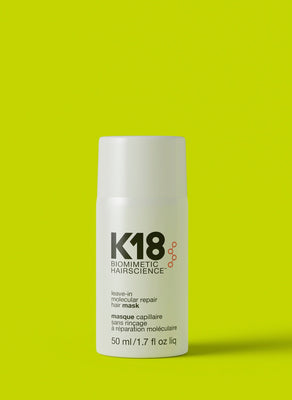
Molecular repair works on the internal structure, which is why it is a different proposition to a conditioner.
[product-feature="k18-retail-leave-in-molecular-repair-hair-mask-50ml"]
[collection-carousel="treatment-routine"]
Is Any Of It Genetic
Partly, and it sets your starting point rather than your destiny.
Baseline cuticle thickness and fibre structure vary with genetics and ancestry, so two people can begin from different places. Some hair genuinely starts with more tightly packed cuticle layers than others.
But damage does the heavy lifting. Someone who began with dense cuticle and bleached three times will end up more porous than someone who began with less and never touched it.
The Only Real Reset
Growth. That is the entire list.
Hair grows around a centimetre a month, so the length sitting on your shoulders today will take a couple of years to be fully replaced. Every centimetre of that new growth arrives with an intact cuticle and low porosity, and stays that way exactly as long as you let it.
Which means the porosity question is really two questions. What can I do about the hair I have, and what am I doing to the hair that is coming?
-
For the hair you have. Support it structurally, coat it well, handle it gently, and trim what is beyond help.
-
For the hair that is coming. Reduce the causes above, in the order listed.
Our guide to preventing bleach damage is where to start on the second one, and repairing bleached hair covers the first.
[product-feature="damage-shield-ph-protective-shampoo"]
[collection-carousel="maintenance-routine"]
The Short Version
-
Porosity is a damage report, not a hair type you were born with.
-
It is governed by the cuticle, so anything that damages the cuticle raises it.
-
The float test measures surface tension and residue, not porosity.
-
Real measurement uses water uptake, dye uptake and microscopy.
-
Bleaching is the biggest cause, then chemical colour, then heat, then UV and friction.
-
One strand carries several porosities, because the ends are years older than the roots.
-
Hair is dead keratin with no capacity to heal, so torn cuticle does not grow back.
-
Conditioners coat and mask. Structural repair works inside. Neither restores virgin hair.
-
Genetics set your starting point, and damage decides the rest.
-
The only true reset is new growth, at about a centimetre a month.
Your porosity changed because something changed it. That is annoying, and it is also the useful part, because it means the next two years of growth are entirely up to you.
