

Your hair feels like it has a film on it. Styling products sit on top instead of sinking in, your blow dry drops within the hour, and no amount of washing seems to reset it. Scalp build up and hard water are the two explanations you will hear first, and a chelating shampoo is usually the fix that gets recommended before anyone has worked out what the coating actually is.
That order is backwards. A deep cleanse only helps if there is something on the hair to remove. When the coated feeling comes from a damaged cuticle rather than a deposit, a stronger shampoo makes it worse. So before you buy anything, it is worth learning to tell the difference, because the three most likely causes each need a different response.
What Coated Hair Actually Is
The word build up covers two completely different things that behave differently in the shower.
Mineral deposits versus product residue
Mineral build up comes from your water. Research on water hardness metal uptake has found that hair picks up calcium and magnesium from tap water, and those two are the deposits with the clearest evidence behind them. Iron and copper get named just as often in everyday advice, though the evidence for them settling on hair is thinner than the confidence with which they are usually listed. Product residue is the other kind, and that is oils, silicones, waxes and styling polymers layering up over successive washes. Both feel similar in the hand. Only one responds to a chelating shampoo.
Ordinary shampoo is not built to shift minerals. Standard surfactants are formulated to lift oils and sebum rather than to bind metal ions, so a normal wash tackles the mineral half of the problem far less effectively than the product half. That is a difference of design rather than an absolute, and a strong clarifying formula will still reduce some visible dulling.
When the problem is not build up at all
Here is the part that gets skipped. Hair that has been lightened, over-processed or heat stressed develops a roughened, lifted cuticle, and that texture reads as coated or waxy to the touch even though nothing is sitting on it. Studies of chemically and thermally treated hair consistently describe raised and fragmented cuticle scales after bleaching and heat exposure, which is exactly the surface change that feels like a film. If your hair also stretches and stays stretched when wet, or feels spongy at the mid lengths, you are almost certainly looking at damage rather than deposits. Our notes on what to do about gummy, coated hair and on hair that has lost its elasticity cover how to tell those apart properly.
The quick test. Deposits make hair feel uniformly slick or dull from roots to ends and improve noticeably after one deep cleanse. Damage feels worst where the hair is oldest and most processed, and a deep cleanse changes nothing or makes it feel rougher.
Why Hard Water Affects Some People And Not Others
One of the most common reasons people rule out their water is that someone else in the house is completely unaffected. Same shower, same tap, same mineral load, and one person has flat, coated hair while the other gets compliments.
Porosity, density and treatment history
Water hardness is only half the equation. The other half is how readily your hair takes on what is in that water. Fine hair has less surface area and less mass to distribute a deposit across, so the same quantity of mineral shows up as limpness far sooner. Porous hair, which usually means colour treated, lightened or heat stressed hair, has a lifted cuticle that plausibly lets minerals settle in rather than rinse off.
It is worth being straight about the strength of that last point. Mineral uptake by hair is well documented, but the direct comparison between porous and low porosity hair has not really been tested, and experts infer it from how a lifted cuticle behaves rather than from head to head evidence. Treat it as a sensible working explanation rather than a settled fact, which is also why the household comparison is a clue rather than a diagnosis.
Where the evidence is much firmer is what metal in the fibre does during a chemical service. Metals such as copper and iron react with the peroxide used in lightening, and work on chelating agents in bleaching systems has shown this reaction drives extra radical formation and fibre weakening. That is one of the quieter causes of uneven lift and breakage, and it is worth reading alongside how to protect hair through a bleach service.
When your hair changes but your water does not
Texture is not fixed. Hormonal change through menopause is well documented as reducing hair diameter and density, so hair that never had an issue with your water can start behaving differently on exactly the same routine. Whether porosity shifts too is less established, so the honest framing is that the hair arriving at your shower is not the hair you had ten years ago. If the coated feeling arrived without any change to your products, our guide to hair through menopause is a useful place to start.
Clarifying, Chelating Or Detox, Which Wash Does What
These three labels get used interchangeably on packaging and they are not the same job. Choosing by symptom is far more reliable than choosing by the word on the front.
| Wash type | What it removes | How it works | Choose it when |
|---|---|---|---|
| Clarifying | Oils, silicones, waxes, styling product | Higher levels of stronger surfactants | Hair feels heavy or greasy, products stop performing, scalp feels congested |
| Chelating | Calcium, magnesium, metal traces, chlorine residue | Binding agents that grip metal ions so they rinse away | Hard water at home, regular swimming, dullness, brassiness in blonde, toner fading fast |
| Detox | Both deposits at once | Surfactants plus binding agents in one formula | You cannot tell which cause you are dealing with |
How chelating shampoo works
A chelating agent is a molecule that wraps around a metal ion and holds it in a soluble form so the rinse can carry it out. Reviews of the physical chemistry behind how shampoo works describe these as genuinely separate mechanisms, with surfactants cleaning by lowering surface tension and emulsifying oils while chelation works by complexing metal ions. That is why a clarifying wash can leave hair squeaky and still dull.
Formulation guidance also shows that plenty of everyday shampoos contain a small amount of a binding agent purely as a stabiliser, often around a tenth of a percent, to stop trace metals causing discolouration or spoiling the preservative system. That is a long way from being formulated to strip deposits, so the claim on the front of the bottle is worth less than what the product is actually built to do.
How often to reset
Weekly suits swimmers, anyone in a genuinely hard water area, and heavy product users. Fortnightly to monthly is plenty for everyone else. Be aware that published advice on cadence varies quite a bit, from after every swim at one end to monthly at the other, so treat any specific number as a starting point and adjust to how your hair actually responds. Deep cleansing more often than your hair needs is its own problem, because you strip the lipids that keep the cuticle smooth and end up with the dull, rough feel you were trying to fix.
The Causes Hiding In Your Routine
Two culprits get missed almost every time, and both are free to test before you spend anything.
Your conditioner is a deposit too
Conditioners work by depositing a layer of conditioning agents that stays on the hair. That is the point of them, and it means every conditioner contributes something to the coating. Whether richer formulas and solid bars leave measurably more behind than lightweight liquids is widely repeated but not well established, so treat it as worth testing on your own hair rather than as a rule. Either way, people auditing their routine for a culprit tend to look hard at styling products, water and shampoo, then skip straight past the thing they apply every single wash.
Washing technique before product changes
Surfactants exist to make water clean better. They cannot do that without physical contact with the whole scalp, and they cannot carry anything away without a thorough rinse. A lot of coated hair is simply hair that has been shampooed across the top and rinsed for twenty seconds. Work the lather into the scalp with your fingertips rather than the lengths, and rinse for longer than feels necessary.
Whether a second wash helps is genuinely debated. Some find that washing twice, with the deep cleanse first, is what finally shifts stubborn residue. Others find one thorough wash does the same job when the shampoo is strong enough and the scalp is properly scrubbed. Treat it as a troubleshooting step rather than a rule.
If a shower filter is on your shopping list, check what it is actually rated to do. Softening works by exchanging calcium and magnesium ions out of the water, which is how water softeners are defined in technical guidance, while most shower filters are built for chlorine, odour and sediment instead.
[tip-text="A handful of specialist shower units do claim to soften, but they are the exception. If hardness is the confirmed cause, the fix is at the tap rather than in the shower head."]
What The Research Actually Shows
- Chemical and heat treatment measurably roughen and lift the cuticle, so hair really can feel coated with nothing on it. This is the best supported idea here and the one most often missed.
- Chelation and surfactant cleansing are separate mechanisms, which is why the right wash matters more than a stronger wash.
- Metal in the fibre reacting with peroxide during lightening is well evidenced, and it is the strongest practical reason to chelate before a colour service rather than after one.
- Over cleansing has a real cost. A systematic review of hair lipids links surfactant driven lipid loss to dull, rough, breakable hair, which is the outcome a deep cleanse is supposed to prevent.
- Wash frequency is less settled than it sounds. A clinical study on shampoo frequency found more frequent washing improved scalp and hair measures overall, which cuts against the common instinct to simply wash less.
- The idea that porous hair holds minerals more than virgin hair is plausible and widely repeated, but the head to head evidence is not there yet. Use it to guide a hunch, not to rule your own water in or out.
What To Do Next
A reset sequence that does not backfire
Start by identifying which problem you have using the test above. If deposits are the answer, the sequence that works is deep cleanse, then rebuild, in the same wash.
- Saturate hair fully with warm water before any product goes near it, so the deposit is already loosened.
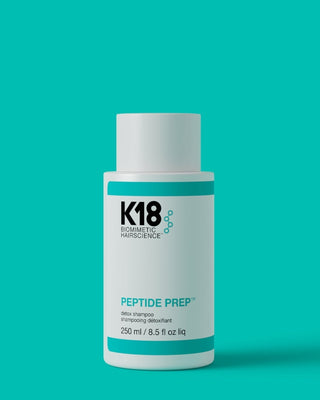
- Use a targeted professional chelating treatment when hard water or pool exposure is the known cause, or reach for a detox shampoo that clarifies and chelates in one step when you are not certain which deposit you are removing.
- Concentrate the product on the scalp and let it sit for a few minutes rather than rinsing straight away.
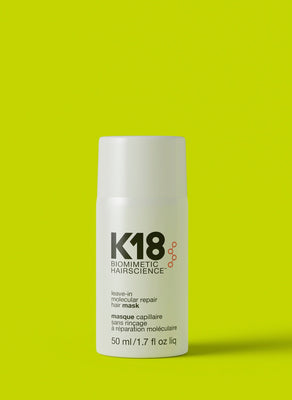
- Rinse thoroughly, then follow immediately with a molecular repair mask. Clean hair takes up what comes next more readily, which makes the moment straight after a deep cleanse a sensible time to repair.
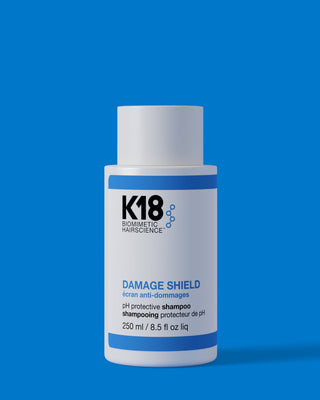
- Return to a gentler everyday wash such as a pH protective shampoo between resets, rather than staying on a deep cleanser.
[product-feature="new-k18-peptide-prep-pro-chelating-hair-complex"]
[collection-carousel="shampoo"]
Keeping it from coming back
If your hair is already compromised, sequence matters more than strength. Repeated stripping on hair that is porous to begin with trades one problem for a worse one, and the rebuild step is what makes the reset sustainable. Our approach to treating hair that is already damaged is the right companion to any deep cleansing routine.
[product-feature="k18-retail-leave-in-molecular-repair-hair-mask-50ml"]
[collection-carousel="treatment"]
What To Realistically Expect
A genuine mineral or product deposit lifts in one wash, and the change is obvious. Hair moves, takes styling again, and looks brighter under light rather than flat. If one properly executed deep cleanse changes nothing, stop washing harder. You are dealing with damage, and the answer is repair and time, not a stronger detergent.
Hard water is a condition to manage rather than a problem to solve once. Match the wash to the deposit, rebuild straight afterwards, and keep the deep cleanse occasional. That is the whole strategy, and it beats stripping your hair every few days hoping the coating finally lets go.
