
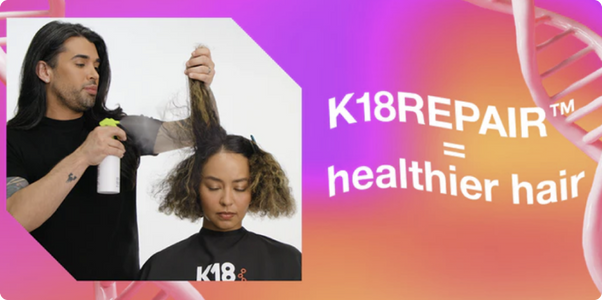

The most common question we get after someone buys their first repair treatment is some version of: how long until I see a difference? It is a fair question, and the honest answer has two parts. Some of what a good treatment does happens the first time you use it. The rest builds up over weeks, and a few things you might be hoping for sit largely outside what any product can do. This article sorts those apart so you know what to expect from your routine, and when.
The honest answer: part now, part later
A single bond-building treatment can improve strength and feel on the same day you use it. That is real. The K18PEPTIDE works inside the hair fibre to reconnect broken keratin chains, and the process takes about four minutes per use. After you rinse and dry, hair often feels smoother through the mid-lengths, combs through with less drag, and has more bounce when you tug a wet section. You are not imagining it.
What a single use will not do is permanently reverse months or years of damage. Damaged hair has gaps in its internal structure from heat, colour, bleach and friction. One treatment repairs a portion of those broken bonds. The next use repairs more. Lasting change is cumulative, which means the difference between week one and week six is bigger than the difference between your first wash and your second. We have written about the biology behind this in more detail in why hair health takes time, and it is worth a read if you want the full picture.
There is also a hard limit worth naming. Hair you have already grown cannot be regrown from the root, so badly damaged lengths and split ends often need to grow out and be trimmed away before the hair reads as fully healthy. That is a months-long process measured by how fast your hair grows, which is roughly one to one and a half centimetres a month for most people.
Why timelines differ by what you want
Most people lump every hair goal into one bucket and expect it all to move on the same schedule. It does not. Different goals run on different clocks, and the product that helps with one will not touch another.
- Repair and strength: days to weeks. You feel the first improvement immediately, and breakage keeps dropping as you keep treating.
- Moisture and frizz: immediate to a few days. Smoothing and slip respond fast because they are partly about coating and conditioning the outer fibre.
- Density and shedding: months, and partly outside what haircare controls. Shedding is driven by your hair growth cycle, hormones, stress, iron levels and genetics. A treatment can stop breakage that thins your lengths, but it cannot change how many hairs your scalp grows.
- Colour-fade protection: measured per wash. A treatment that reduces porosity helps colour hold from one wash to the next, so you judge it across a wash cycle rather than waiting weeks.
The reason this matters for expectations is simple. If you bought a repair treatment hoping for thicker hair in two weeks, you will be disappointed, not because the product failed, but because density was never the job it was built for. Match the product to the goal, then match your patience to that goal's real timeline.
A realistic week-by-week repair timeline
Here is what a consistent bond-building routine tends to look like over six weeks for hair that is damaged but not severely compromised. Yours may run faster or slower depending on how porous your hair is and how often you wash.
| Goal | Realistic timeline | How to judge progress |
|---|---|---|
| First treatment | Same day | Less drag when combing wet, more bounce, smoother mid-lengths |
| Strength and reduced breakage | Weeks 1 to 3 | Fewer broken hairs on the towel and in the basin after washing |
| Moisture and frizz control | Days to week 2 | Hair stays smoother for longer between washes, less flyaway |
| Elasticity and overall condition | Weeks 3 to 6 | Wet strands stretch and recover instead of snapping |
| Growing out damaged lengths | Months | New growth looks healthy while old damage is trimmed away over time |
The pattern to notice: the first column moves fast, the last column moves slowly, and most of the satisfying change lands in the middle weeks as the repairs stack up.
Why using more product does not speed things up
There is a tempting logic that says if a little repairs some bonds, a lot must repair more, faster. It does not work that way. The K18PEPTIDE only reconnects bonds that are currently broken and accessible. Once the available bonds in a given session are addressed, extra product has nothing left to do that round, so it rinses away without adding benefit. Doubling the dose mostly doubles what you waste.
Consistency is what actually moves the needle. Hair takes on damage continuously from washing, heat styling, brushing and sun, so repair is less a one-off fix and more an ongoing balance. Treating regularly keeps you ahead of new damage rather than letting it pile up between rare, heavy applications. A small, frequent dose used as directed beats a big, occasional one almost every time.
- Follow the dose on the pack rather than guessing upward.
- Keep a steady rhythm, every wash or every few washes depending on the product, instead of saving it for a big occasion.
- Give a new routine at least four to six weeks before deciding whether it works.
How to tell if something is actually working
People often judge a treatment on one wash and a glance in the mirror, which is the least reliable way to assess it. Lighting, the cut, how you dried it and your mood all colour that snapshot. Better to track a few concrete signals over a few weeks.
- Breakage on the towel: count, roughly, how many short broken hairs you see after towel-drying. Fewer over time is the clearest sign repair is working.
- Elasticity when wet: gently stretch a single wet strand. Healthy hair stretches a little and springs back; damaged hair snaps. More give over the weeks means better internal condition.
- Shine: look at how light sits on the surface in the same spot and lighting each time. A smoother fibre reflects more evenly.
- Comb glide: notice how much resistance you feel dragging a comb from mid-length to ends. Less drag week on week tells you the surface is in better shape.
None of these is a single miracle wash. Taken together across a month, they give you an honest read that no one-off look in the mirror can.
Building the cumulative routine
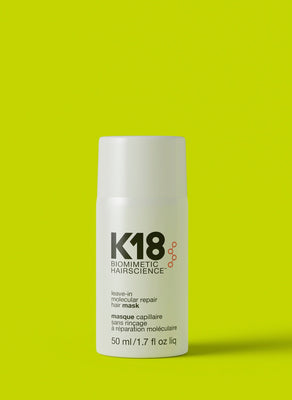
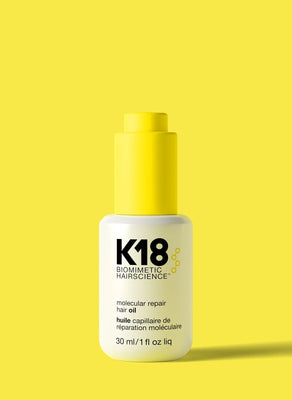
For most people the everyday repair routine is two products doing two jobs. A molecular repair oil smooths the surface, adds shine and protects against heat and friction, which is where you feel a fast, same-session difference. A leave-in molecular repair mask does the deeper structural work, reconnecting broken bonds with the K18PEPTIDE so that strength and elasticity build over the weeks. Used together and consistently, they cover both the immediate feel and the long game.
[product-feature="k18-retail-leave-in-molecular-repair-hair-mask-50ml"]
[collection-carousel="treatment"]
For goals that sit on the longer horizon, our science-led Future IQ range launches in July and is built around exactly this idea of cumulative, measurable change rather than a single dramatic wash. We would rather tell you plainly that some results take weeks than promise an overnight transformation and let you down. If your goal is the kind that takes months, the honest move is to set your expectations to that timeline from the start.
What to take away
A bond-building treatment gives you something real on day one and more with every use after. Strength and breakage improve over the first few weeks, moisture and frizz respond within days, colour holds wash to wash, and density mostly answers to factors a treatment cannot reach. Using more does not rush it, consistency does, and the fairest way to judge any treatment is to track breakage, elasticity, shine and comb glide over a month rather than to expect a miracle from one wash. Set the right clock for the right goal and the results will meet you there.
