


Most people do not notice hair thinning when it starts. They notice it months later, usually in a photo taken under bright light, or the morning a hair tie wraps around the ponytail one extra time. By then the change has been underway for a while. The earliest signs of hair thinning are quiet, and that is exactly why they get missed. Learning to read them early gives you more options, because the sooner you understand what is happening, the more you can do about it.
Shedding and thinning are not the same thing
This is the distinction that matters most, and it trips up almost everyone. Shedding is about the number of hairs you lose. Thinning is about the diameter of the hairs that grow back. You can shed heavily for a few months and recover completely. You can also shed a fairly normal amount while each new hair grows in finer than the one before it, which is the pattern behind most long-term loss.
That second pattern has a name: miniaturisation. The follicle is still alive and still producing hair, but each growth cycle yields a slightly thinner, shorter, less pigmented strand. Over years, a head of coarse hair quietly becomes a head of fine hair, and the overall density drops even though you might not see clumps in the drain. So if you have been asking why is my hair thinning when you are not losing handfuls, miniaturisation is often the answer.
| Sign | What it usually means | What to do |
|---|---|---|
| More hairs in the brush or shower, lasting weeks | Increased shedding, often telogen effluvium | Look back 2 to 3 months for a trigger; see a GP if it continues past 3 months |
| Ponytail feels thinner, parting looks wider | Reduced density, possible miniaturisation | Track it with photos; ask about ferritin and thyroid bloods |
| New regrowth is fine, soft and baby-like | Strands growing back smaller each cycle | Worth a trichologist or GP review, especially if it is patterned |
| Sudden patches of loss | Not typical thinning; needs assessment | See a doctor promptly |
The first signs of hair thinning people tend to miss
The earliest cues are visual and tactile, and they are easy to explain away one at a time. Put together, they tell a clearer story. These are the first signs of hair thinning worth watching for:
- Your parting looks a little wider than it used to, especially toward the crown, and more scalp shows through under direct or overhead light.
- The ponytail circumference shrinks. You notice the elastic going around an extra time, or the tail simply feels lighter in your hand.
- You are finding more hairs in the brush, on the pillow or around the plughole, and it has carried on for weeks rather than a few days.
- New growth along the hairline or part comes in fine, soft and almost baby-like compared with the rest of your hair.
- Styles that used to hold no longer have the same body, and your hair takes less product to feel flat.
One of these on its own is not a verdict. Light changes. Seasons change shedding patterns. But a wider part plus a smaller ponytail plus finer regrowth, all at once and sustained, is a pattern worth respecting.
What a normal day of hair loss looks like
Here is the baseline that lets you self-assess. Losing roughly 50 to 100 hairs a day is normal for most people, a figure the American Academy of Dermatology uses in its patient guidance. Hair grows in cycles, and at any moment around 5 to 10 per cent of your hair is in the resting (telogen) phase, waiting to fall so a new hair can take its place. Wash days and brush-throughs concentrate that loss, so seeing more hair after two or three days without washing does not mean something is wrong.
What you are looking for is a change from your own normal that lasts. A few heavy days mean little. The same heavy shed every day for two or three months is the signal.
Why hair thinning happens
There is rarely a single cause, but a handful of drivers explain most cases.
Genetics is the big one. Androgenetic hair loss, the inherited kind, affects a large share of people of every gender as they age and is the classic example of miniaturisation. In women it often shows as widening of the part and loss of density across the top of the scalp, while the hairline holds. It tends to creep rather than crash, which is part of why it goes unnoticed early.
Telogen effluvium is the shedding type, and it is usually a delayed reaction. A stressful event, a serious illness, a high fever, surgery, crash dieting or childbirth can push a big batch of follicles into the resting phase at once. The shed typically shows up two to three months after the trigger, which is why people often cannot connect the two. The good news is that this kind of loss is usually temporary and recovers once the trigger has passed.
Nutrition matters more than people expect. Low iron stores are a common and correctable contributor, and ferritin (your stored iron) is the marker to check, not just haemoglobin. Low vitamin D has been linked to hair loss in several studies, though the picture is still being worked out. Rapid weight loss and restrictive eating can trigger shedding on their own.
Thyroid problems, both under and overactive, change hair growth and texture, and the loss is often diffuse across the whole scalp. Finally, age itself plays a part: as the years pass, growth cycles shorten and strands naturally grow finer, so some thinning is simply part of ageing rather than a disease.
When to see a GP or trichologist
If the change has lasted beyond three months, is getting worse, comes with patches, or arrives alongside symptoms like fatigue, weight change or feeling cold, book in with your GP. The sensible first step is bloods: ferritin and a thyroid panel cover two of the most common and treatable causes, and your doctor may add others depending on your history. A trichologist can assess the scalp and the pattern of loss directly, and a dermatologist can diagnose and treat androgenetic loss. Going in with a couple of dated photos and a rough timeline makes that first appointment far more useful.
What haircare can and cannot do
This is where honesty matters. No shampoo, mask or serum can regrow a follicle that has stopped producing hair, and no topical product reverses genetic miniaturisation on its own. Anyone promising that is overselling. What good haircare does is protect the hair you still have.
That distinction is more useful than it sounds, because breakage mimics thinning. When strands snap mid-length from heat, colour, friction or chemical damage, the result looks and feels exactly like reduced density: less body, a wispier ponytail, more short broken hairs standing up along the part. If your hair is breaking, you are losing length and volume you would otherwise keep. Addressing that is one of the few things home care genuinely controls.
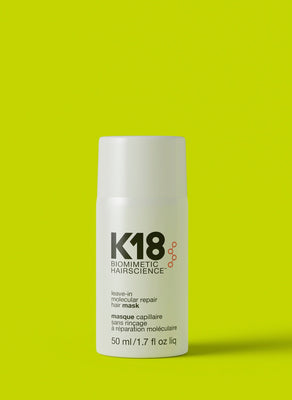
The K18PEPTIDE works at this level. It is designed to reach into the hair and help reconnect the keratin chains and disulphide bonds that heat and chemical services break, which restores strength and reduces the breakage that thins hair from the outside in. Pair that with a gentle scalp routine, soft elastics instead of tight ones, lower heat and less mechanical tugging, and you give every strand the best chance of reaching full length and diameter.
[product-feature="k18-retail-leave-in-molecular-repair-hair-mask-50ml"]
Where a science-led range fits in
Protecting existing hair handles one half of the problem. The follicle side, density and shedding and pigment, is a harder scientific question, and it is the focus of K18 Future IQ, launching in July. It is built as a science-led anti-ageing range aimed at density, shedding and the loss of pigment that comes with age. We would rather let the clinical data set the expectations than make promises ahead of it, so look for the published results when it arrives and judge it on those. If you are already noticing early signs, it is a development worth keeping on your radar alongside the medical checks above.
The short version: read the early signals, get your bloods done, protect the hair you have from avoidable breakage, and treat any product as one part of a bigger plan rather than a cure on its own.
[collection-carousel="bestsellers"]
