

The first grey hair is rarely the one you were expecting. It shows up at a temple or in a parting, you catch it under a particular light, and you spend the next three weeks looking for the others. There are usually a few others.
Greying is one of the most universally human things that happens to a body, and we still do not have a clean cure for it. What we do have, in the last five years, is a much sharper picture of what is actually happening inside the hair bulb. The science is moving. It is not moving in the direction of a single pill or a single shampoo, but it is moving.
What is actually going on at the root
Every hair follicle has a small population of melanocytes sitting near the hair bulb. Melanocytes are the cells that produce melanin, the pigment that gives hair its colour. They are not active all the time. They switch on during the growth phase of the hair cycle and they switch off when the hair sheds. The pigment is loaded into the keratin as the strand is built. That is why a single strand can be silver at the root and dark at the tip. The pigment was added on the day that section of hair was made.
The supply chain runs like this:
- Stem cells live in a region of the follicle called the bulge.
- They migrate down to the bulb and mature into pigment-producing melanocytes.
- New growth comes through coloured.
- When the supply chain breaks down, new hair grows through grey, then white.
That last point is the one most people get wrong. Your hair is not turning grey. Each new strand simply comes through without pigment. The interesting question is why the supply chain breaks down.
Premature greying and age-related greying are not the same thing
Greying before about age 30 is described in the trichology literature as premature canities. It usually has a strong family pattern. If one of your parents went grey early, your odds of doing the same are high. Some health conditions can also accelerate it, and these are worth ruling out with a GP before assuming the cause is genetic:
- Pernicious anaemia and B12 deficiency.
- Chronic thyroid disease.
- Vitiligo, which involves a related loss of melanocytes.
Age-related greying is a different story. It typically starts at the temples in your thirties or forties and progresses slowly toward the rest of the scalp. By age 50, around half of all people have at least 50 percent grey hair, according to a large survey published in the British Journal of Dermatology in 2012. The other half are mostly catching up by 60. The progression is gradual, not a single event.
The oxidative stress angle
The dominant working theory for age-related greying involves oxidative stress. Every melanocyte in your scalp produces hydrogen peroxide as a by-product of its normal work. In a healthy follicle, an enzyme called catalase breaks the hydrogen peroxide down into water and oxygen before it can do damage. As we age, catalase production slows. Hydrogen peroxide builds up. It bleaches the melanin from the inside out and it damages the melanocyte stem cells over time.
This is not speculation. A 2009 paper in the FASEB Journal measured elevated hydrogen peroxide in the hair follicles of greying individuals, with depleted catalase and repair enzymes. It is one of the most cited papers in the field and it has held up well.
The model also explains a few things people notice anecdotally:
- Smokers tend to go grey earlier, because cigarette smoke carries a heavy free-radical load.
- Some patients on long-term immunosuppressants report faster greying for the same reason.
- The pathway is not unique to hair. Pigment production is one of the first things the body deprioritises when cellular machinery is under strain.
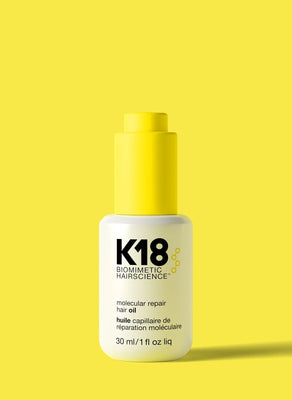
If you want a single product that already works on the broader health of your existing hair while the science on greying catches up, the molecular repair oil is the one our team reaches for first.
[product-feature="k18-molecular-oil-30ml"]
What about stress
The cliche about a shocking event turning someone grey overnight is mostly a cliche. Almost nothing in human biology can produce a fully grey hair instantly, because the pigment is loaded into the strand at the bulb, not at the tip. You cannot wave a wand at the lengths and have them lose their colour.
What stress can do is empty the melanocyte stem cell pool faster. In 2020, a team at Harvard published a paper in Nature showing that acute stress in mice triggered a noradrenaline release that depleted the melanocyte stem cells in the follicle. Once depleted, the cells did not come back, and new growth came through grey. The mice did not go grey overnight, but they did go grey faster than the control group. The mechanism is plausible in humans because we have the same sympathetic nerves running into our follicles.
So stress is not the cause. It is more like an accelerator, sitting alongside genetics and oxidative load.
What does and does not help
The supplement industry around greying is generous with promises and thin on evidence. Here is how the common claims hold up against the data:
| Approach | What the evidence shows | Worth it |
|---|---|---|
| Biotin supplements | No good clinical data showing it slows or reverses greying in people who are not deficient. Deficiency is rare on a normal diet. | Only if blood-tested deficient |
| B12, copper, L-tyrosine | Correcting a genuine deficiency may help your particular pattern. Oversupplementing past sufficiency shows no meaningful effect. | Only to correct a deficiency |
| Dietary antioxidants (vitamin C and E from food) | Modest circumstantial support for slowing progression. Will not restore lost colour. | Yes, through real food |
| Sleep and consistent exercise | Reduce systemic inflammation. Circumstantial support only. | Yes, for general reasons |
| Stopping smoking | Removes one of the clearest accelerants of early greying. | Yes |
The honest summary is that none of this will put colour back into hair that has already lost it. The best the current evidence supports is slowing the progression.
Where the science is going
Three lines of research look promising enough to mention:
- Targeting hydrogen peroxide directly. A pseudo-catalase compound was trialled in vitiligo patients in the early 2000s, with some pigment recovery. Results for general greying were less clear, and the work has continued in European dermatology labs.
- Melanocyte stem cell preservation. The Harvard paper that mapped the stress pathway opened a door. If the stem cell pool can be protected during the stressed years, the pigment supply chain has a better chance of staying intact.
- Long-term cellular haircare. K18 has a science-led range called Future IQ launching in July, aimed at the ageing-hair audience. It targets density, shedding and pigment together, framed as long-term cellular health rather than a topical cover-up. The final claims should be driven by the clinical data, and that data is what we will be reading closely once it is published.
If you want to get your hair into its best possible condition before any of that lands, start with the products that already have the clinical backing.
[collection-carousel="bestsellers"]
What to do in the meantime
A few practical calls:
- If your first grey is showing up earlier than feels normal for your family, see a GP and rule out B12, iron and thyroid before spending a year on a supplement that was never going to help.
- If it is showing up on schedule and you are not enjoying it, that is a personal call. Colour it, do not colour it, blend it. The biology will keep doing its thing regardless.
- The clearest things working against you are smoking, chronic under-sleeping, and ignoring an underlying nutrient deficiency. Everything else sits on a long curve.
Hair greying is one of the most visible signs of cellular ageing, and that is what makes it interesting. The hair is showing you, at the surface, what your cells are doing underneath. The next decade of research is about reading that signal properly, not just covering it up. We are still some distance from a reversal product that works for most people. We are not so far from a slowdown product that works for some people. That is real progress, even if it is slower than the morning your first grey hair found you.
